


One of our keywords ranks at position 1.1. Functionally, the top spot on Google.
In a recent 30-day stretch it was shown 1,555 times.
It earned zero clicks.
Not "low CTR." Zero. The query is "what are the top social media platforms," and if you search it, you'll see why: the answer assembles itself at the top of the results page, in an AI overview and the boxes around it, before any blue link gets a vote.
Ranking #1 used to be the trophy. On queries like this one, it's a participation medal.
Every SEO publication has now written the "AI Overviews are eating your traffic" piece, and the studies behind them are real. What almost nobody publishes is the part you can act on: how to measure, on YOUR site, with data you already have, which queries are exposed, how hard you're actually being hit, and what to reallocate toward.
That's this article. Panic optional, measurement mandatory.
- The studies are directionally consistent: organic CTR on queries with AI Overviews fell roughly 61% in Seer's data, and most informational searches now end without a click. But averages aren't your site.
- Exposure follows intent: definitional and list queries get absorbed hardest; comparison, transactional, and branded queries far less.
- The fingerprint in Search Console: impressions steady or rising, clicks falling, position unchanged. Visibility intact, click gone.
- The response is reallocation, not rage: make your content citable, shift targets toward click-surviving intents, and stop judging content on clicks it can no longer earn.
What the studies actually say
The numbers behind the panic, cited honestly:
- Seer Interactive measured organic CTR on queries showing an AI Overview falling from 1.76% to 0.61%, a 61% drop, with paid CTR falling too.
- SparkToro's 2026 analysis puts US Google searches ending without any click at 68%, up from about 60% two years earlier.
- Semrush's intent research found roughly three quarters of informational searches end clickless, versus under a third of transactional ones.
- The counterweight: brands actually cited inside AI Overviews earn measurably more clicks than uncited competitors on the same SERPs (one widely-reported analysis put it around +35% organic).
Three honest readings of those numbers.
First, the effect is real and large on the exposed query classes. This is not a "wait it out" event.
Second, it's wildly uneven. "Three quarters of informational searches end clickless" coexists with transactional queries that still click through at old rates. Averages across the whole web tell you almost nothing about your site's mix.
Third, the citation upside is real. AI Overviews quote sources, and being the quoted source is the new featured snippet: fewer total clicks on the query, disproportionate share to the cited.
Which is why the only number that should drive your decisions is your own exposure, measured next.
Which of your queries are exposed
Exposure follows what the query wants. The ladder, from most absorbed to least:
- Definitional: "what is X", "what are the top X", "X meaning". The AI answer IS the product. Our zero-click poster child lives here.
- List and fact queries: "X statistics", "best X examples", dates, numbers, thresholds. Absorbed nearly as hard.
- Quick how-tos: "how to do X" where X fits in five steps. The overview summarizes your five steps; the click evaporates.
- Comparisons and evaluations: "X vs Y", "best X for Y", reviews. Partially absorbed; buyers still click for depth and trust.
- Transactional: pricing, tools, downloads, purchases. Lightly touched; the SERP can't sell you the thing.
- Navigational and branded: barely touched; people looking for you still click you.
Map your query portfolio against that ladder and you have your theoretical exposure before opening a single report. A documentation-heavy content site lives at the top of the ladder; a product-led site with brand demand lives at the bottom.
We're an SEO-tools portfolio, so our informational content lives high on the ladder, and it shows: across our sites, the overwhelming majority of our top-10 informational queries convert under 1% of impressions into clicks. The full site-level exposure audit is its own upcoming article; today's job is the per-query diagnosis.
The absorption fingerprint in GSC
Here's the pattern that separates "AI Overview absorbed my clicks" from ordinary ranking problems:
- Impressions: steady or rising. You still qualify for the SERP; you may even show more, since AIO pages scroll long.
- Average position: unchanged. You didn't lose your spot.
- Clicks and CTR: down, sometimes off a cliff. The searcher got their answer above you.
That triple is the absorption fingerprint, and it's diagnostic gold, because every other traffic-loss cause moves impressions or position too (the triage covers them all). Rankings drop: impressions fall with position. Decay: impressions slide over months. Absorption: position holds, impressions hold, clicks leave.
One honesty note: the fingerprint tells you clicks are being absorbed above you, not precisely by what. AI Overviews are the biggest new absorber, but featured snippets, People-also-ask boxes, and ad stacks do the same thing. For response purposes it rarely matters which box took the click; the plays are the same.
Running the audit on your own site
Thirty minutes in Search Console, or five with tooling.
- Pull your top-10 queries. Performance report, filter position under 10.5, sort by impressions. These are the queries where clicks were yours to lose.
- Flag the informational ones. Question words, "what/how/why", list phrasing, definitional shapes. A regex filter like
^(what|how|why|when|which)gets you most of the way. - Compare actual CTR against expected CTR for the position. This is the CTR-gap method, using the published curve. A position-3 query converting at 0.3% against an expected 10% is either absorbed or mistitled; a whole class of them converting near zero is absorption.
- Check the trend, not just the level. For the worst offenders, look at the 12-month view: impressions flat or up while CTR decayed marks when the absorption arrived.
- Total the damage honestly. Expected clicks minus actual clicks across the exposed set equals what absorption costs you monthly. That number, not a headline, is what should size your response.
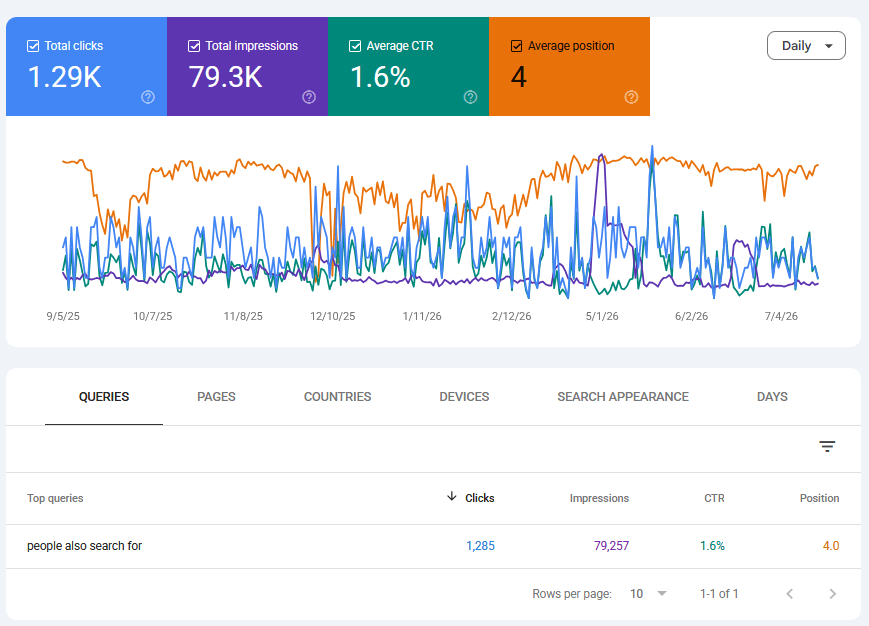
The fingerprint in the wild: eleven months of one informational query, position pinned near 4 while the CTR line walks downstairs.
The audit, automated: our CTR Optimization report runs the expected-vs-actual comparison across every top-10 keyword daily, so the absorbed queries surface themselves. Free, from your own Search Console data.
The three response plays
Play 1: become the citation. AI Overviews cite sources, and citations click. What earns citations looks suspiciously like what earned featured snippets: direct, quotable answers high on the page; specific claims with numbers and dates; clean heading structure; schema where it fits; and being the origin of a fact rather than the fifteenth summary of it. Original data is the strongest citation magnet there is (it's why we publish ours).
Play 2: shift weight down the ladder. In your keyword strategy, deliberately rebalance toward query intents that still click: comparisons, evaluations, tools, templates, calculators, anything interactive or transactional. This doesn't mean abandoning informational content; it means no longer judging it on clicks it can't earn. Adjust targets, or measure it on impressions and citations instead.
Play 3: concentrate on what's yours. Brand queries and product queries still convert at full rate. The boring, compounding play of building brand demand got more valuable the day the SERP started answering generic questions itself.
What not to do
Don't blanket-block AI crawlers as a "strategy." Blocking AI agents out of spite doesn't restore your clicks on AIO queries and may remove you from the citation pool, the one upside available. If you block, do it as a deliberate content-licensing decision, not a tantrum.
Don't rewrite pages that lost un-winnable clicks. A definitional query converting at 0.2% from position 2 is not a title problem, and the twentieth rewrite won't fix it. Spend that effort on play 1 or 2.
Don't chase every overview. Some AIO citations are worth winning (high-volume, adjacent to your product). Most aren't worth a content sprint. Prioritize by the expected-clicks math, same as everything else.
Common mistakes
Five ways this gets misread.
- Measuring the whole site instead of the exposed class. Blended CTR hides absorption behind your brand and transactional queries. Segment first, always.
- Calling every CTR drop "AI Overviews." The fingerprint requires impressions AND position to hold. If impressions fell, you have a ranking problem, and a different article.
- Judging informational content on clicks it can no longer earn. Update the scorecard, or you'll delete content that's still doing brand and citation work.
- Ignoring the citation opportunity. Fewer clicks distributed more unevenly means the cited source wins bigger than before.
- Forecasting from old CTR curves. If your planning still assumes 25-30% CTR at position 1 on informational queries, every projection you make is fiction. Use conservative curves and your own observed data.
FAQ
- Do AI Overviews reduce organic traffic?
- On the queries where they appear, yes, substantially: Seer Interactive measured organic CTR falling 61% on queries with AI Overviews, and most informational searches now end without a click. The impact concentrates on definitional, list, and quick-answer queries; transactional and branded queries are far less affected.
- How do I know if AI Overviews are affecting my site?
- Look for the absorption fingerprint in Search Console: impressions steady or rising, average position unchanged, clicks and CTR falling. That triple means the SERP is answering above you. Audit your top-10 informational queries against expected CTR for their positions to size the exposure.
- How do I get cited in an AI Overview?
- The same qualities that won featured snippets: direct, quotable answers placed high on the page, specific claims with numbers and dates, clean structure, relevant schema, and original facts or data that make you the source rather than a summarizer. Cited brands measurably out-earn uncited ones on the same SERPs.
- Should I block AI crawlers?
- Blocking is a content-licensing decision, not a traffic-recovery tactic. It won't restore clicks on queries with AI Overviews, and it can remove you from the citation pool. Decide it on business grounds; don't expect SEO gains from it.
- Do AI Overviews appear on transactional queries?
- Far less often, and with less click absorption when they do. Intent research shows roughly a third of transactional searches end clickless versus three quarters of informational ones. Pricing, tool, and purchase intent still clicks through, which is why rebalancing toward those intents is a core response.
- Is SEO still worth doing with AI Overviews?
- Yes, with a reallocated scorecard: citations and impressions for informational visibility, clicks for transactional and branded queries, and original data as the citation magnet. The sites in trouble are the ones still measuring 2021-style clicks on queries that stopped paying them.
Find the queries where your position is fine and your clicks are gone
The CTR Optimization report compares every top-10 keyword's actual CTR against the expected curve for its position, daily, from your own Search Console data. Absorbed queries float straight to the top of the gap list. Free for Keywords Everywhere users.
Run the absorption audit