


In the same week this spring, two keywords on our own sites fell off a cliff.
The first dropped from position 8.5 to position 25.4 overnight. Page 1 to page 3, in one day.
The second dropped from 8.5 to 16.7. Page 1 to page 2.
If you'd seen either one in your rank tracker, your stomach would have done the thing. Mine did.
Here's what happened next. The first keyword was back within the week, at position 6.4, better than before the drop. We changed nothing. The second keyword never came back. Months later it still sits around 16.
Same-looking drop. Opposite realities. And everything you should do about them is different.
So before this article gives you the cause checklist you came for, it's going to make you answer a question almost no "rankings dropped" guide starts with: was the drop even real?
Because across 250 keywords we watched for 11 weeks on our own sites, 144 had at least one overnight drop of 8 positions or more. And 82 of those, 57%, healed completely within a week while nobody touched anything.
More than half of scary drops are weather.
- Across 250 of our keywords over 11 weeks, 57% of big overnight drops (8+ positions) fully recovered within a week, untouched. Verify a drop is real and sustained before you spend a fix on it.
- Diagnose with four questions in order: Is it real? Is it everywhere or one page? Did impressions fall or just clicks? Does the date line up with a known event?
- The most common real causes, roughly in order: algorithm updates, content decay, cannibalization, SERP features absorbing clicks, technical accidents.
- The worst response is a same-day rewrite. The best response is a 10-minute GSC diagnosis, then the one fix that matches the fingerprint.
First question: is the drop even real?
Google's results genuinely wobble.
Positions are re-computed constantly, tested constantly, and personalized per searcher. A keyword's "position" is an average over many different searches, so a day with a few unusual searches (different countries, different devices, a SERP test) can print a terrifying number that means nothing. I wrote about the noise floor in the daily rank tracking article, and volatility mechanics are a topic I'll return to soon.
The practical rule we use, and the reason our alert thresholds are tiered by position: a drop only graduates from weather to signal when it's both big for its position range and sustained.
- Positions 1-10: a move of 3+ that holds for 3+ days is signal. A one-day spike of any size is weather until it repeats.
- Positions 11-30: 5+ sustained.
- Positions 31+: 10+ sustained, and honestly, at that depth position noise is enormous and clicks are near zero anyway.
Our two keywords from the intro: the first ("buy keywords", an informational query we rank for) printed one catastrophic day and healed. The second ("best seo blogs") printed a smaller drop that held for weeks. The second one was the emergency. The first was a Tuesday.
So: look at 7 days of positions, not one. If the drop hasn't held for 3+ days, close the tab and check back Thursday.
If it has held, keep reading.
The four-question triage
Answer these in order. Each answer cuts the suspect list in half.
1. Is it real? Covered above. If no: stop.
2. Is it everywhere, or one page/keyword? Open GSC, compare this week to last week, and look at the whole property first. If clicks and impressions fell across most pages, you're looking at a site-level event: an algorithm update, a sitewide technical problem, or (rarely) a manual action. If one page or one keyword cluster fell while the rest held, it's a page-level story: decay, cannibalization, a competitor, a SERP change on that query.
3. Did impressions fall, or just clicks? This is the most diagnostic single check in SEO and almost nobody does it. Impressions falling with clicks means you lost visibility: rankings genuinely dropped. Impressions steady while clicks fell means you're still ranking where you were; something on the results page is absorbing your clicks (an AI overview, a featured snippet, an ad pack). That second case is not a ranking drop at all, and no amount of ranking work will fix it. I covered that structural-CTR problem in the CTR by position article.
4. Does the date line up with a known event? Check the drop date against Google's update announcements, your own deploy and change log, your CMS's plugin update history, and the calendar (seasonality, holidays). A drop that starts the exact day of a core update announcement is probably the update. A drop that starts the day your "site cleanup" shipped is probably you.
The cause table: fingerprints and first moves
| Cause | How common | The fingerprint | Your first move |
|---|---|---|---|
| Normal volatility | Extremely | One-day spikes, recovers within a week | Wait. Seriously. |
| Algorithm update | Common | Site-wide, starts on an announced update date | Read the update's focus; audit against it; expect months, not days |
| Content decay | Common | One page, gradual slide, impressions falling | The decay refresh playbook |
| Cannibalization | Common | Keyword holds at site level, but the ranking URL flip-flops | Consolidate or differentiate: the cannibalization guide |
| SERP feature arrived | Common | Impressions steady, clicks down, position unchanged | Win the feature, or target click-worthy variants |
| Technical accident | Occasional | Sudden, often site-wide or one template; impressions collapse toward zero | Check indexing, noindex, robots.txt, canonicals TODAY |
| Lost backlinks | Occasional | One page slides weeks after losing a strong link | Check link data; rebuild internal links first |
| Manual action | Rare | GSC tells you explicitly under Security & Manual Actions | Read the notice; fix exactly what it says |
Two honest notes on that table.
Most guides list fifteen causes as if they're equally likely. They're not. Volatility, updates, decay, cannibalization, and SERP features cover the overwhelming majority of real cases.
And "a competitor outranked you" isn't a separate row because it's not a separate cause; it's the mechanism behind most decay and update losses. The fix is the same: be better than the page that passed you.
The 10-minute diagnosis in Google Search Console
Here's the exact sequence, using only free tools.
- Performance report, compare mode. Last 7 days vs previous 7 (or 28 vs 28 for slower declines). Note whether clicks AND impressions fell, or clicks only.
- Pages tab, same comparison. Sort by click difference. Is the loss concentrated in one page, one section, or spread everywhere?
- Queries tab, filtered to a losing page. Which queries lost? Branded or non-branded? One cluster or all of them?
- Click the worst query and check the position line. Sudden step down, gradual slide, or flat position with falling clicks? You now know which row of the cause table you're in.
- Device and country splits. A mobile-only or one-country drop points at SERP layout or localization, not your content (the mobile rankings lesson).
- Pages report (indexing). If impressions collapsed toward zero, check whether the page is even indexed before theorizing about algorithms.
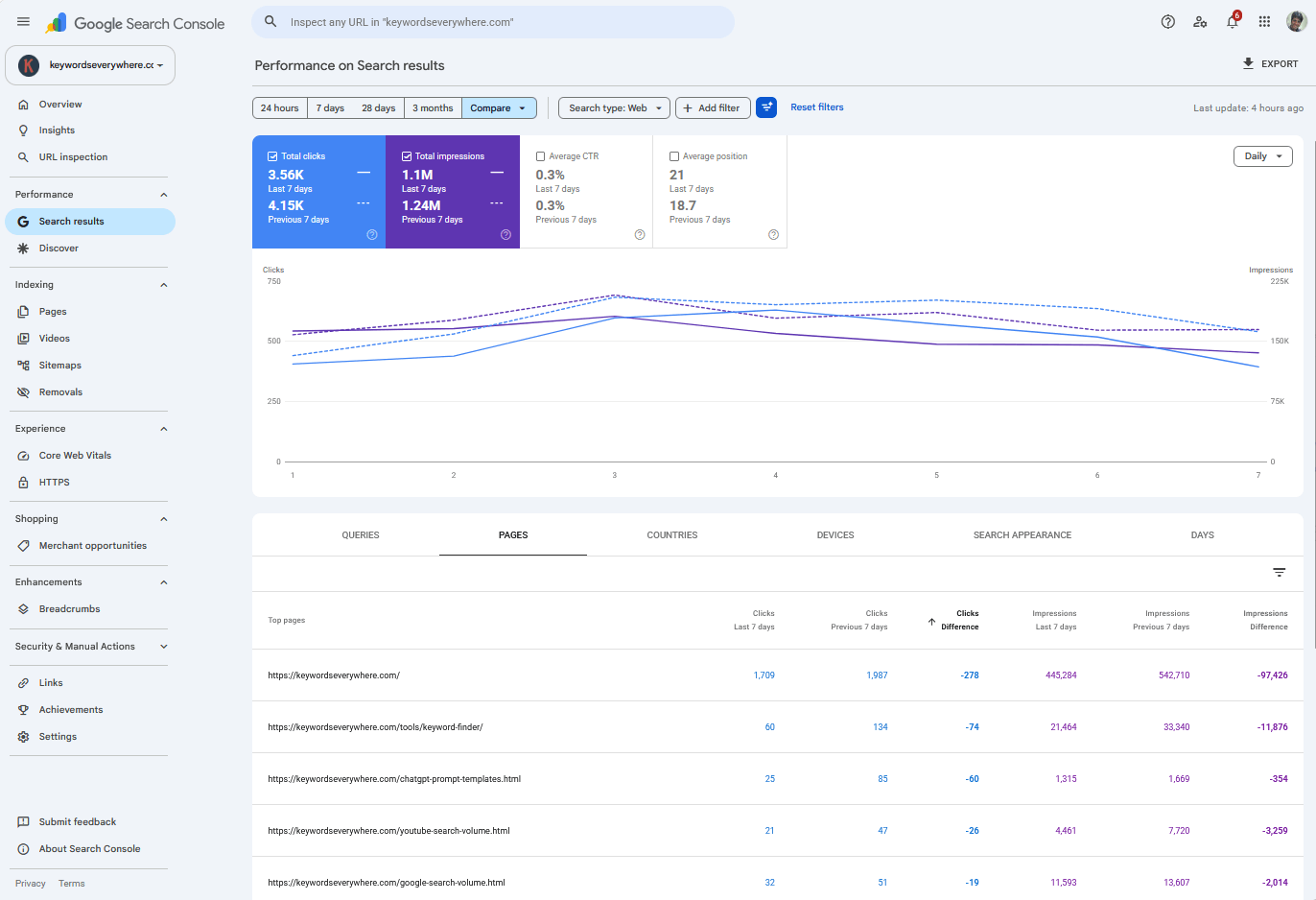
Compare mode answers questions 2 and 3 of the triage in about ninety seconds.
Ten minutes, and you'll know the pattern, the scope, and the likely row of the table. That's more diagnosis than most panicked site owners ever do.
What NOT to do in week one
The damage in ranking-drop stories usually comes from the response, not the drop.
Don't rewrite the page the same day. If the drop is volatility (a 57% chance for a one-day spike, remember), your rewrite adds risk to a page that was fine. If it's an update, Google's own guidance is that recovery follows sustained improvement over months; a panic rewrite optimizes for your anxiety, not the algorithm.
Don't churn titles daily. Title changes take days to weeks to be re-evaluated. Changing them faster than Google re-reads them means you can't attribute anything.
Don't disavow anything. Ranking drops send people running to disavow files. Unless you actually bought links and received a manual action that says so, this is cargo-cult surgery.
Don't compare across different date ranges, devices, or countries and call it a drop. An honest comparison holds everything constant except time.
Do: write down what you observed (dates, scope, fingerprint), make the one change the diagnosis points to, and give it 2-4 weeks.
Make sure you know about the next drop same-day
The worst version of this story is discovering a drop six weeks late from a revenue chart.
The fix is boring: alerts with sane thresholds. The reason most people turn ranking alerts off is that most tools alert on noise, every 2-position wobble, until you stop reading them.
That's why ours are tiered by position range (a 3-position move matters at position 5 and means nothing at position 45) and fire on the daily aggregate, not device-level jitter.
Let the drop find you. Website Ranking Checker watches every keyword you track from your own Search Console data and emails you only when a move clears the threshold for its position range. Free, and the tiered thresholds above are the defaults.
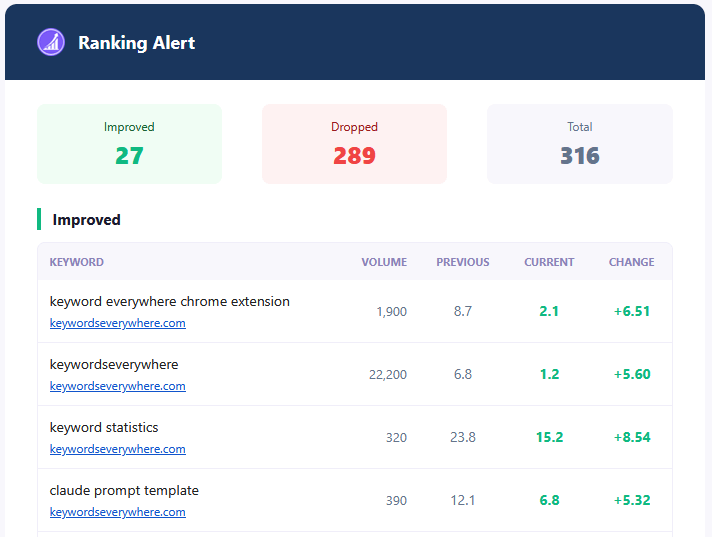
The daily digest: only moves that clear the tiered threshold for their position range make the email.
However you set it up, the goal is the same: compress "drop happened" to "you knew" from weeks to a day. Every cause in the table is cheaper to fix early.
Common mistakes
Six ways ranking-drop responses go wrong.
- Treating one bad day as a trend. The most common mistake, and the most expensive in wasted work. Demand 3+ days of persistence.
- Diagnosing from the rank tracker alone. The tracker tells you THAT something moved. GSC's impressions/clicks split tells you WHAT moved. Use both.
- Assuming it's the algorithm. Updates are common, but so are self-inflicted wounds. Check your own deploy log before blaming Google.
- Fixing everything at once. Five simultaneous changes means zero attribution. One diagnosis, one fix, one measurement window.
- Ignoring drops on page 2+. "It was only position 15 to 28" still cost you the striking-distance spot you'd been building toward. Losses below page 1 are quieter but real.
- Never writing anything down. The next drop will look like this one. A three-line incident note (date, scope, cause, fix, outcome) makes you smarter every time.
FAQ
- Why did my Google rankings suddenly drop?
- The most common causes, in rough order: normal day-to-day volatility (most one-day drops), an algorithm update, content decay as competitors improve past you, keyword cannibalization, a SERP feature absorbing clicks, or a technical accident like an accidental noindex. Check whether the drop has been sustained for 3+ days before diagnosing further.
- How do I know if a ranking drop is real or temporary?
- Look at 7 days of position data instead of one. In our own data, 57% of overnight drops of 8+ positions recovered fully within a week with no intervention. A real drop is both large for its position range and sustained for at least 3 days.
- Do rankings recover on their own?
- Often, yes, when the "drop" was volatility, a SERP test, or an unusual mix of searches for a day. Drops caused by updates, decay, or competitors do not self-heal; they require improving the page or the site. The impressions-versus-clicks split in Search Console tells you which kind you have.
- Did a Google update cause my ranking drop?
- Compare your drop date with Google's announced update rollouts. An update-driven drop is typically site-wide (many pages losing impressions together) and starts within the rollout window. A single page dropping while the site holds steady is usually decay, cannibalization, or a SERP change instead.
- How long should I wait before fixing a ranking drop?
- Three days, to confirm it's sustained. Then diagnose the same day using Search Console's compare mode, and make the one change the diagnosis indicates. Avoid same-day rewrites: half of one-day drops heal themselves, and panic changes make attribution impossible.
- Can checking my rankings too often mislead me?
- Yes. Daily position checks without thresholds turn normal volatility into daily emergencies. Track daily, but act on tiered, sustained thresholds: we use 3 positions sustained for the top 10, 5 for positions 11-30, and 10 beyond that.
Know about the next drop the same day it happens
Website Ranking Checker watches every keyword you track from your own Search Console data and alerts you only when a move clears the tiered threshold for its position range: 3 positions in the top 10, 5 in 11-30, 10 beyond. No noise, no missed drops, free.
Set up drop alerts