


The stat everyone quotes this year: 68% of US Google searches end without a click on anything.
It's a real number (SparkToro's, from clickstream data, up from about 60% two years ago), and it launched a thousand doom posts.
Here's the number those posts never give you: yours.
So I computed ours. Across our portfolio's top-10-ranked queries with meaningful volume (500+ impressions in 30 days), 89 out of 96 convert less than 1% of impressions into clicks.
Ninety-three percent.
Our sites live in an informational niche where the SERP answers most questions before anyone scrolls, and by the industry's framing, we should be inconsolable.
We're not, because once you compute your own exposure you can actually do something rational about it: change what you measure, change what you target, and stop grieving clicks that were never coming back. That's this article: what zero-click really means (three different things, only one of them "lost"), the 20-minute audit that produces your number, and the reallocation that follows.
- Industry-wide, roughly two-thirds of searches end clickless, and informational queries are worst (74% vs 31% for transactional, per Semrush). But the only actionable number is your own.
- "Zero-click" bundles three species: answered-on-the-SERP (your click genuinely absorbed), navigational-satisfied, and query-refinement. Only the first is a loss.
- The audit: your top-10 queries with an impressions floor, actual CTR versus expected-for-position. Ours: 89 of 96 under 1%, a 93% exposure rate, typical for informational niches.
- The response is reallocation: measure informational content on impressions and citations, spend click-effort on transactional and specific queries, and treat SERP presence as the new (lesser, but real) currency.
What zero-click actually means (three species)
A "zero-click search" is any search that ends without a click on a result. Three very different things produce one:
Species 1: answered on the SERP. The AI overview, featured snippet, knowledge panel, weather widget, or calculator answered the question. The searcher got value; no site got the visit. If you rank for these queries, your click was genuinely absorbed. This is the species worth measuring, and the one the AI Overviews piece dissects.
Species 2: navigational satisfaction. Someone searched "youtube" and clicked nothing, because the search WAS the navigation. No click was ever available to win. Panicking about these is like mourning window shoppers who were walking to a specific store.
Species 3: refinement. The searcher looked, learned their query was wrong, and searched again. The "zero-click" search was step one of a two-search journey that may end at your site under a different query.
The industry's 68% blends all three, which is why it reads scarier than any individual site's reality. Your exposure lives almost entirely in species 1, and that's the one the audit isolates.
The 20-minute exposure audit
The question: how much of my top-ranking visibility is being answered above me?
- Pull your top-10 queries. GSC Performance report, position filter under 10.5. These are queries where, historically, ranking meant clicks.
- Apply an impressions floor. 500+ impressions over 30 days (or scale to your size). Below that, CTR percentages are coin flips.
- Compare actual CTR to expected CTR for the position. The published curve says position 3 should earn ~10%, position 5 ~3%. Flag everything earning less than a fifth of expected.
- Classify the flagged. Search each query in an incognito window and look at what sits above you: AI overview, snippet, knowledge panel? Species 1, confirmed. Your own brand navigational query? Species 2, ignore. A vague query where results scatter? Often species 3.
- Compute the exposure rate. Species-1 flagged queries divided by total top-10 queries. That's your number.
Ours: 89 of 96 flagged, and spot-checking confirms the overwhelming majority are species 1: definitional and list queries with answer boxes. A 93% exposure rate, because we write about an informational topic in a feature-saturated SERP neighborhood.
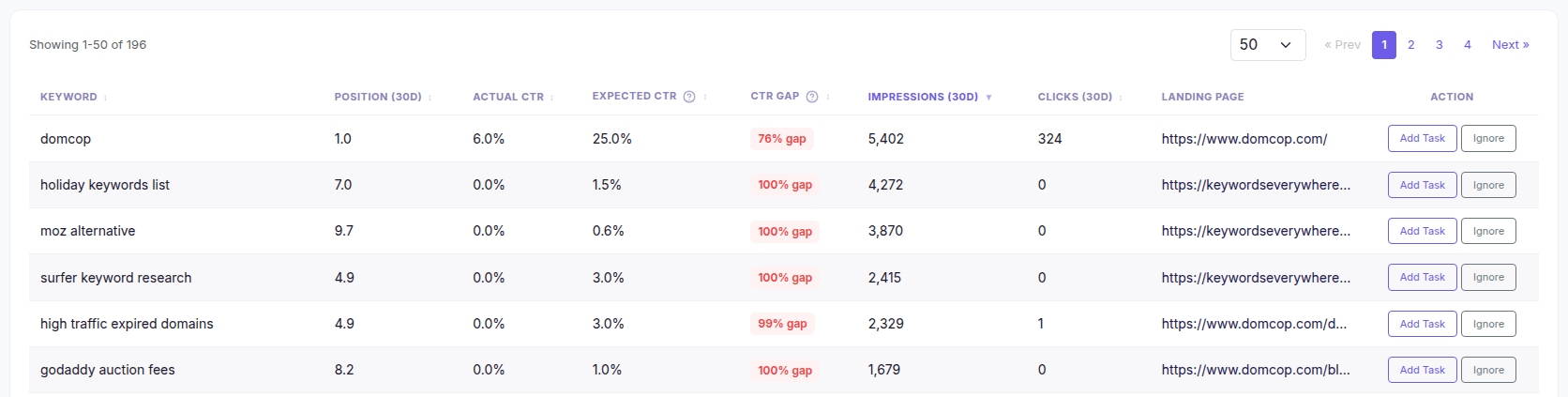
The audit as a standing report: expected vs actual CTR per keyword, refreshed daily. The 100%-gap rows are searches that ended without a single click.
Steps 1-3, automated: the CTR Optimization report maintains the expected-vs-actual list daily from your own Search Console data. You bring the incognito spot-checks; it brings the math.
Reading your number
High exposure (60%+, informational niches): you're us. The SERP answers your niche's questions directly. This does NOT mean your content failed; it means clicks are the wrong scorecard for a chunk of your portfolio (next section). It also means the queries that DO click (specific, long-tail, tool-intent) deserve disproportionate love. The long-tail mining gets you that list.
Medium (30-60%, mixed sites): segment before concluding anything. Your informational cluster probably looks like ours while your product pages look fine; a blended number hides both stories.
Low (under 30%, commerce/local/tools): your queries still click. Guard the positions, watch for new SERP features on money terms, and go spend your energy on rankings rather than this article.
One honest caveat: expected-CTR curves are calibrated on averages, so a high exposure number partly reflects your niche's SERPs and partly your titles. The incognito spot-check in step 4 is what separates "the SERP ate it" from "my snippet is boring," and the fixable-vs-structural table covers the difference.
The reallocation
What we actually changed once we had our number, offered as the playbook:
1. Re-scorecard the informational layer. Pages serving species-1 queries get measured on impressions (visibility), SERP presence, and citations, not clicks. This isn't cope; it's accounting: those pages now do brand-awareness work, and pretending they're click-generators makes good content look broken.
2. Shift new-content weight toward click-surviving intents. Comparisons, evaluations, tools, templates, data: query shapes where the searcher needs your page, not a summary. (The same ladder logic as the AI Overviews response.)
3. Compete for the answer box where it pays. For high-value species-1 queries, being the cited source is the remaining prize: direct answers high on the page, quotable claims with numbers, schema. Win the box or feed it.
4. Protect the clickers. The minority of queries still delivering clicks (ours: the specific, multi-word, tool-adjacent ones) get tracked tightly and defended like revenue, because they are.
Zero-click is not zero-value (with limits)
The consolation-prize argument is real, within limits.
Real: impressions at positions 1-3 are brand exposure at scale (our zero-click poster child still puts our name in front of 1,500+ searchers a month). Citations in AI overviews and snippets carry disproportionate clicks to the cited. People-also-ask presence compounds visibility.
The limits: impressions don't pay hosting bills, brand lift per SERP glance is small, and "we got seen a lot" has a short shelf life with stakeholders. The honest framing for reports: visibility metrics for the informational layer, click and conversion metrics where clicks still exist, never one masquerading as the other. (How to report both without spin.)
Common mistakes
Five exposure misreadings.
- Measuring your site against the industry 68%. Species mix and niche make that number incomparable to yours. Run your own audit.
- Treating all zero-click as loss. Navigational satisfaction and refinement were never your clicks. Only answered-on-SERP counts as exposure.
- Fixing titles on species-1 queries. If the SERP answers above you, snippet polish moves nothing. Diagnose before rewriting.
- Abandoning informational content entirely. It still builds the authority that ranks your transactional pages, earns the citations, and feeds the brand. Change its scorecard, not its existence.
- Ignoring exposure creep on money queries. The audit isn't one-time: a new SERP feature landing on a transactional query is an alert-worthy event. Watch CTR trends, not just positions.
FAQ
- What is a zero-click search?
- A search that ends without a click on any result: the searcher was answered directly on the results page (AI overview, featured snippet, knowledge panel), was navigating rather than researching, or refined their query and searched again. Recent clickstream research puts zero-click at roughly 68% of US Google searches.
- What percentage of searches are zero-click?
- SparkToro's 2026 analysis measured 68.01% of US Google searches ending without a click, up from 60.45% in 2024. The rate is intent-dependent: Semrush found about 74% of informational searches end clickless versus 31% of transactional ones.
- How do I measure zero-click exposure for my own site?
- Audit your top-10-ranked queries with 500+ monthly impressions: compare each query's actual CTR to the expected CTR for its position, flag those far below (under a fifth of expected), then spot-check the SERPs to confirm an answer feature sits above you. Flagged queries divided by total is your exposure rate.
- Are zero-click searches bad for my site?
- Only the answered-on-SERP kind costs you anything, and only on queries where you rank. High exposure means clicks are the wrong metric for that content layer, not that the content failed: measure it on impressions and citations, and concentrate click-effort on specific, transactional queries that still click through.
- How do I compete with zero-click SERPs?
- Two ways: become the source the answer feature cites (direct quotable answers, specific data, clean structure, schema), and rebalance targeting toward query intents that still click: comparisons, tools, templates, and specific long-tail questions that summaries can't satisfy.
- Should I stop targeting informational keywords?
- No, but re-scorecard them. Informational content builds the topical authority your transactional rankings stand on, earns AI-overview citations, and generates brand impressions at scale. Judge it on visibility and citation metrics; judge transactional content on clicks and conversions.
Your exposure number, computed daily
The CTR Optimization report compares every top-10 keyword's actual CTR against the expected curve, from your own Search Console data, so your zero-click exposure list maintains itself. The audit from this article, running every morning. Free for Keywords Everywhere users.
See your exposed queries