


Somewhere around 2015, "ranking #1 on Google" quietly stopped meaning "at the top of the page."
Search anything commercial today and organic result #1 sits below an AI overview, a row of ads, sometimes a map, occasionally a video carousel, and a "People also ask" accordion. On a phone, "position 1" can start two screens down.
Each of those boxes is a SERP feature, each one moves clicks around, and each leaves a distinct fingerprint in your Search Console data. Most feature guides list what the boxes look like. This one is organized around what they do to your numbers, because that's the version you can act on: which features you can win, which just tax you, and how to tell from your own data which one is doing what.
Consider it the field guide to everything sitting between you and the click.
- SERP features are everything on the results page that isn't a classic organic link: AI overviews, snippets, People Also Ask, packs, panels. They dominate above-the-fold space on most commercial and informational queries.
- Each feature leaves a fingerprint in GSC: features ABOVE you absorb clicks (position steady, CTR down); features you're IN change your impression and position math in recognizable ways.
- Two playbooks cover the winnable core: the quotable-answer playbook (snippets, AI overview citations) and the question playbook (PAA).
- Run the worth-it math before chasing any feature: some pay in clicks, some in citations and brand presence, and some just tax the query for everyone.
The modern SERP, anatomically
On a contested query in 2026, the page typically stacks: paid ads, an AI overview (on informational queries), a featured snippet OR the overview, People Also Ask, then some mix of local pack, video, images, and shopping depending on intent, and then, finally, the organic results.
Three structural truths follow:
Your "position" counts organic slots only. GSC's position 1 means first ORGANIC result. The features above don't move your reported position while they absolutely move your clicks, which is why the expected CTR curve is a baseline, not a promise.
Feature mix follows intent. Definitional queries get overviews and snippets; commercial queries get ads and shopping; local intent gets the pack (its own separate universe); how-to gets video. Your niche's query mix determines which features are YOUR problem.
Features change faster than rankings. Google adds, removes, and resizes features per-query continuously. A stable position with suddenly different clicks usually means the furniture moved, not you.
The field guide, feature by feature
| Feature | What it is | What it does to your numbers | Winnable? | Pays? |
|---|---|---|---|---|
| AI Overview | Generated answer at top, with citations | Ranked below it: CTR down hard, impressions/position steady. Cited by it: disproportionate share of surviving clicks | As a citation | In citations + surviving clicks |
| Featured snippet | Extracted answer box above organic | Win it: big CTR jump (counted as position 1). Lose it to a rival: the absorption fingerprint | Yes, the classic | Yes, mostly |
| People Also Ask | Expandable question accordion | Mild click tax on everyone; being IN it adds impressions at odd stable positions | Yes, per question | Modestly; compounding presence |
| Local pack | The map + 3 profiles | Organic below it loses clicks on local intent; the pack itself is a separate system | Via your Business Profile, not your site | For local businesses, hugely |
| Video carousel | Row of videos | Click tax on how-to queries unless you're in it | With video content | Only if video fits your model |
| Image pack | Row of images | Mild tax; wins for visual niches | With image SEO | Visual niches only |
| Sitelinks | Extra links under a result | Amplifies the top result (usually brand queries): higher CTR, more real estate | Indirectly (site structure) | Yes, if you're the brand |
| Knowledge panel | Entity box | Absorbs definitional clicks about the entity | Rarely | Brand legitimacy, few clicks |
| Shopping results | Product grids | Commercial queries: organic pushed down | Via product feeds | E-commerce only |
The big four for most sites: AI overviews and snippets (the answer absorbers, dissected here), PAA (the question layer), and, for local businesses, the pack.
The fingerprints in your data
You rarely need a SERP screenshot to know what's happening; the numbers tell you:
Position steady, impressions steady, CTR falling: a feature grew above you. The absorption fingerprint. An overview or snippet is answering before your listing gets seen.
CTR jumped without a position change: you won furniture. Snippet capture is the classic: GSC counts a snippet as position 1, so this sometimes shows as position up + CTR up beyond what one spot explains.
Impressions up at strange stable positions, tiny CTR: you're in the PAA layer. PAA appearances register as impressions at whatever slot the accordion holds; a new stratum of impressions with near-zero clicks and an oddly stable position is often this.
Local-intent queries: organic numbers fine, business flat: the pack owns the click. The two-competitions problem; your organic tracking is telling the truth about the wrong contest.
Run these against your CTR-gap list and most anomalies self-identify.
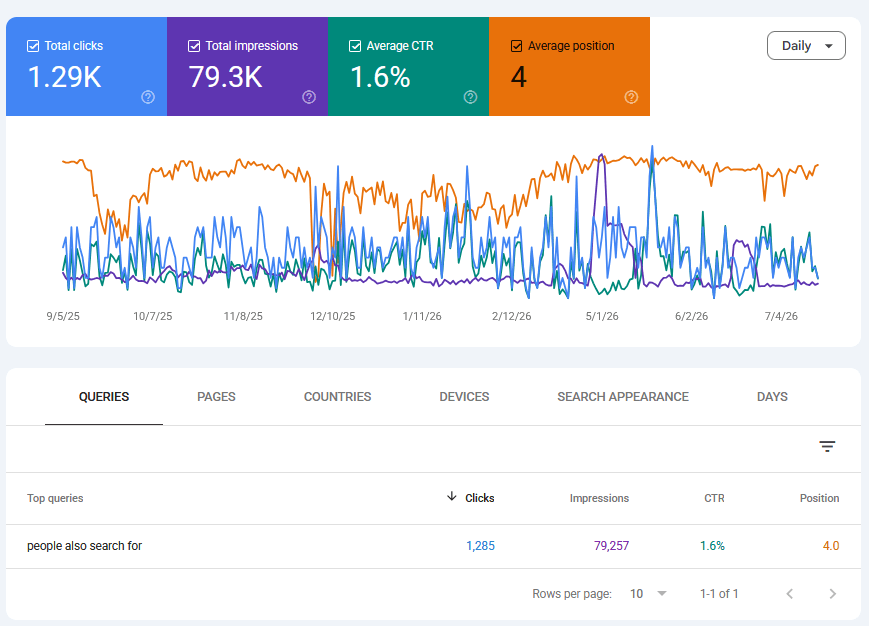
The absorption fingerprint in the wild: the position line flat, the CTR line walking downstairs.
The two playbooks worth having
Most features either can't be won by a website (panels, shopping) or belong to other disciplines (video production, Business Profile management). Two playbooks cover the winnable core:
The quotable-answer playbook (snippets + AI overview citations). The same mechanics win both, because the overview is functionally a synthesized snippet: give the direct answer in the first sentence under a heading that matches the question; keep it self-contained (40-60 words that survive being lifted); use the structure the answer wants (steps as a numbered list, comparisons as a table); add specifics generic pages can't match (numbers, dates, original data, the reason we publish ours); mark it up where schema fits. Then check who currently holds the box and be more liftable than they are.
The question playbook (PAA). Mine the questions your audience actually asks (the regex method), give each its own heading with a concise first-paragraph answer, and mirror the phrasing. PAA presence compounds: one good answer seeds appearances across related accordions.
Both playbooks are also, not coincidentally, the zero-click era's citation strategy: when the SERP answers, be the answer's source.
The worth-it test
Before chasing any feature, thirty seconds of math:
- What do I gain? For snippets: the gap between snippet CTR and your current position's CTR, times impressions. For PAA: modest impressions, compounding presence. For citations: the survival-share of a shrinking click pool.
- What does it cost? A restructure of one section (low effort) versus new content formats (video: a real production line).
- Is the query already answer-saturated? A definitional query whose overview fully satisfies may pay in brand presence only. That can still be worth it, but price it as brand, not traffic.
The general rule from this whole thread: specific queries pay in clicks, definitional ones pay in presence, and pretending otherwise on either side wastes quarters.
Feature changes announce themselves in your CTR gaps. The CTR Optimization report recomputes expected-versus-actual for every top-10 keyword daily, so when furniture lands on a money query, it's at the top of a list instead of buried in a chart. Free for KE users.
Common mistakes
Five feature-related mistakes.
- Optimizing titles against a feature problem. If the box above you answers the query, your meta description isn't the issue. Fingerprint first.
- Chasing every snippet. Win the ones where the click math pays; skip the answer-saturated trivia.
- Reading a snippet win as a plain position-1 ranking. GSC reports both as position 1; know which you have, because losing a snippet looks like a mysterious CTR collapse at "the same position."
- Ignoring features in forecasting. Click projections from position moves fail on feature-heavy SERPs; that's why conservative curves exist.
- Fighting the pack with website SEO. Local pack visibility runs through your Business Profile, not your title tags.
FAQ
- What are SERP features?
- Everything on a Google results page that isn't a traditional organic listing: AI overviews, featured snippets, People Also Ask boxes, local packs, video and image carousels, sitelinks, knowledge panels, and shopping grids. They dominate above-the-fold space on most queries and materially change how clicks distribute.
- How do I get a featured snippet?
- Answer the target question directly in the first sentence under a matching heading, keep the answer self-contained (roughly 40-60 words), use the format the answer wants (list for steps, table for comparisons), and include specifics the current holder lacks. Check who owns the snippet now and structure your answer to be easier to lift.
- Do SERP features reduce organic clicks?
- Features above your listing do: queries with AI overviews saw organic CTR fall dramatically, and snippets, ads, and packs all absorb clicks from results below them. Features you WIN (snippets, PAA slots, citations) shift the math in your favor: fewer total clicks on the query, more of them yours.
- What is People Also Ask and is it worth targeting?
- The expandable question accordion appearing on most informational SERPs. Being in it adds impressions and compounding presence for modest individual clicks. It costs little to target if you're already structuring content around real audience questions with concise answers.
- How do I know if a SERP feature is affecting my pages?
- Read the fingerprint in Search Console: position and impressions steady while CTR falls means a feature is absorbing clicks above you; a CTR jump beyond what one position explains often means you captured a snippet; new impressions at stable odd positions with near-zero CTR suggest PAA appearances.
- Are SERP features worth optimizing for?
- Selectively. Run the math: expected clicks gained (or citation presence, for answer features) against the effort. Snippet wins on commercial-adjacent queries usually pay; answer-saturated definitional queries pay in brand presence rather than traffic; and packs, panels, and shopping belong to other playbooks entirely.
Know when the furniture moves
The CTR Optimization report flags every top-10 keyword earning less than its position should, daily, from your own Search Console data, which is exactly what it looks like when a feature lands on your query. Fingerprint first, fix second. Free for Keywords Everywhere users.
Watch your SERPs' furniture