

Why Rankings Fluctuate Every Day: SERP Volatility and the Google Dance That Never Stopped

Twenty-something years ago, Google updated its index about once a month.
For a few days each month, rankings would shuffle chaotically as the new index rolled across Google's datacenters. You could search the same keyword twice and get two different result pages depending on which datacenter answered. SEOs named the phenomenon "the Google Dance," built tools to watch it, and scheduled their panic for the week it ran.
Then Google went to continuous indexing, the monthly shuffle disappeared, and everyone declared the dance over.
Here's the thing our data says: the dance didn't end. It went continuous.
We measured day-over-day position changes for about 400 keywords across 11 weeks, roughly 30,000 daily readings. A keyword ranking on page 3 or deeper moved 2.4 positions on the MEDIAN day. Not on a bad day, on a typical one. One day in four, it jumped five positions or more, with nobody doing anything.
Even in the calm waters of the top 10, one reading in eight moved three or more positions day-over-day.
If you track rankings and don't know these numbers (or your own version of them), every ordinary Tuesday looks like an emergency. So this article is the measurement: why positions genuinely wobble, how big normal is at each depth, and how to set thresholds so the dance stops paging you.
- Daily ranking movement is structural, not a sign something's wrong: Google re-ranks continuously, runs experiments constantly, and your "position" is an average over a shifting mix of searches.
- Measured on our own keywords: top-10 rankings move a median 0.5 positions/day; positions 11-30 move 1.5; positions 31+ move 2.4, and jump 5+ positions one day in four.
- Noise scales with depth. That's why sane alert thresholds are tiered: 3 positions in the top 10, 5 at 11-30, 10 beyond.
- Industry volatility sensors measure the whole web's weather. Your own portfolio's volatility spiking is a better update detector for you.
The dance that never stopped
The original Google Dance (roughly 2000-2003) was a monthly event: Google rebuilt its index, pushed it datacenter by datacenter, and for a few days rankings depended on which datacenter you hit. SEOs called the mid-rollout churn "dancing."
Google killed the monthly rebuild in 2003 with rolling updates (the era SEOs called "everflux"), and by the 2010s indexing and ranking were fully continuous.
Which means the modern situation is this: instead of a monthly dance you could see coming, there's a permanent low-grade shuffle, punctuated by named update windows when the music gets loud (how to verify those).
People searching "google dance" today are usually asking one of two questions: "what was that?" (answered above) or "why are my rankings dancing RIGHT NOW?" (answered below, with numbers).
Why positions genuinely wobble
Five structural reasons, none of which involve anything being wrong:
Continuous re-ranking. Google re-evaluates results constantly: freshness signals, new pages entering, links appearing and dying. The index you ranked in this morning is not this evening's index.
Experiments, permanently. Google runs SERP experiments at all times: reordering results, testing features, holding out traffic slices. Some fraction of your impressions is always happening inside somebody's A/B test.
Your "position" is an average over a shifting mix. The position you see in Search Console is averaged across every search that showed you: countries, devices, personalization contexts. When today's mix skews toward a country where you rank worse, your average "moves" without any ranking changing (the blend problem).
Low-impression noise. A keyword seen 12 times today has a position computed from 12 samples. Sample sizes that small guarantee jumpy averages, which is why deep, low-volume keywords look like seismographs.
Query demand shifts. News events, seasons, and trends change who searches and what Google serves them. The SERP for a query during a news spike is a different SERP.
Add those up and daily movement isn't a bug; it's the baseline. The only question is how big the baseline is, and that's measurable.
The noise floor, measured
Our measurement: about 400 non-branded keywords with at least 60 days of daily position data, 11 weeks, roughly 30,000 day-over-day readings, grouped by each keyword's typical position band.
| Position band | Median daily move | 80th percentile | 95th percentile | Days with a 3+ move | Days with a 5+ move |
|---|---|---|---|---|---|
| 1-10 | 0.5 | 1.9 | 6.5 | 12.9% | 6.9% |
| 11-30 | 1.5 | 3.9 | 8.9 | 27.1% | 14.1% |
| 31+ | 2.4 | 5.8 | 11.8 | 42.8% | 24.5% |
Three findings worth staring at.
Noise scales with depth. The top 10 is genuinely stickier: half-position typical days, and even the 95th-percentile day moves only about 6.5. Down on page 4, a 5-position jump is a Tuesday (it happens one day in four), and the 95th-percentile day moves nearly 12.
"My keyword moved 4 positions!" means completely different things at different depths. At position 6, a 4-position move is a 95th-percentile event worth investigating. At position 35, it's below the median-week experience. Same number, opposite meanings.
Sustained beats size. Even the big single-day moves mostly revert (57% of 8+ position drops healed within a week in our related measurement). Persistence over 3+ days is what separates a real move from a loud day.
Your site's exact numbers will differ (query mix, volumes, niche), but the shape, noise growing with depth, is universal, because the causes above all hit low-impression, low-stability rankings hardest.
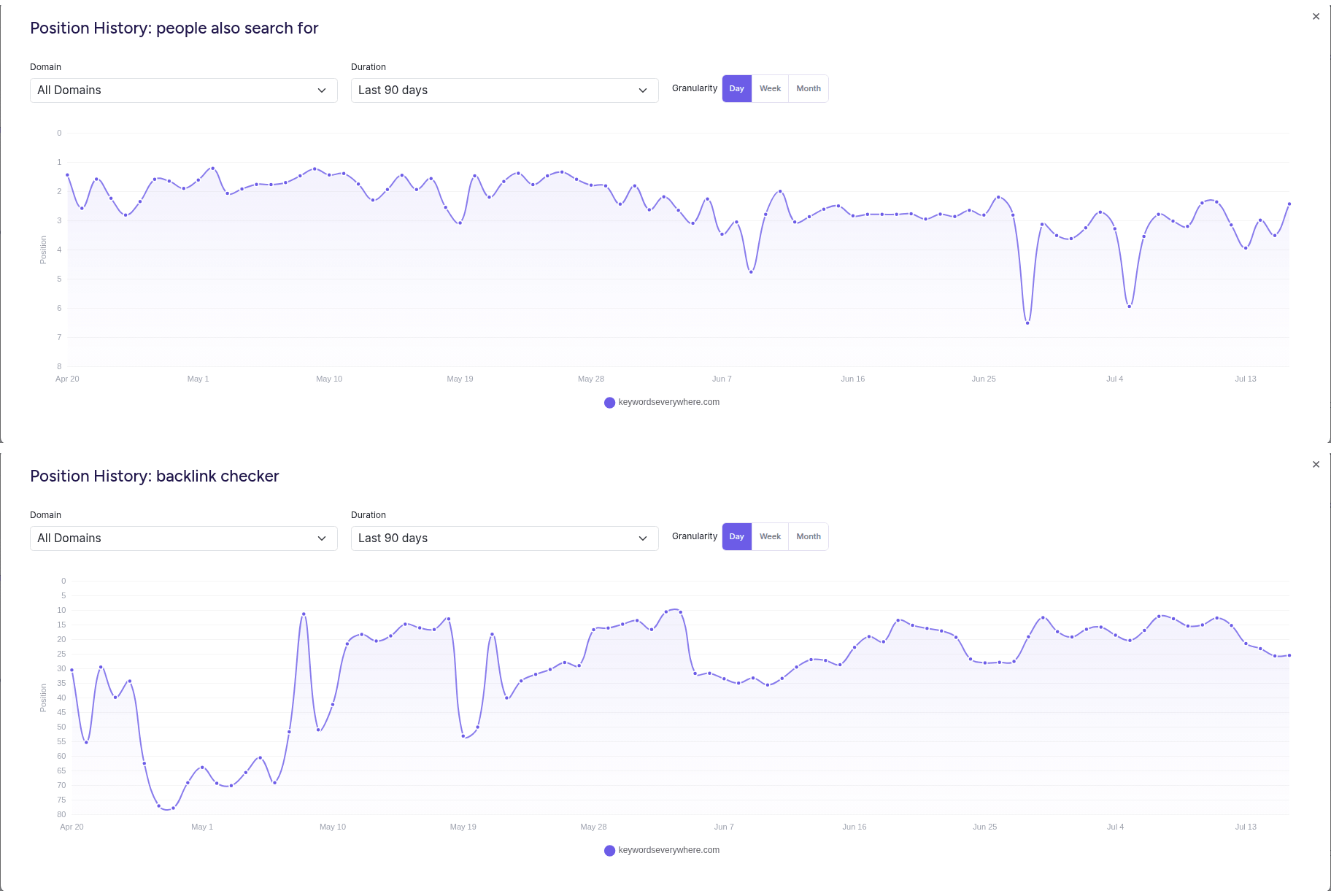
The same site, the same weeks: a top-10 keyword's calm line versus a page-3 keyword's seismograph.
Turning noise into thresholds
The table is why our alert thresholds are tiered the way they are:
- Top 10: alert at 3+ positions. A 3-position move happens on ~13% of days, so requiring it (plus persistence) puts alerts safely past the daily weather.
- 11-30: alert at 5+. Three-position moves happen 27% of days here, far too common to alert on. Five sits above the band's 80th percentile.
- 31+: alert at 10+. Even 5-position moves happen a quarter of days. Ten approaches the 95th percentile, and honestly, below page 3, position changes barely matter until they're huge.
The general recipe if you want to derive your own: alert at roughly your band's 95th-percentile daily move, and require it to hold for multiple days. Anything looser and you're subscribing to weather reports. (The full tracking setup uses these defaults.)
These defaults ship pre-tuned. Website Ranking Checker alerts on 3/5/10 by position tier out of the box, computed on the daily all-devices aggregate so device jitter can't fake a signal. Free for Keywords Everywhere users.
What volatility sensors actually measure
The industry's volatility trackers (Semrush Sensor is the best known; several tools run similar indices) measure aggregate SERP flux: how much the top results changed across a big basket of monitored queries, industry by industry.
Useful for exactly one thing: confirming "is it just me?" When your rankings shake AND the sensor spikes, something ecosystem-wide is happening (usually an update rolling out). When your rankings shake and the sensor is calm, the story is local to you.
Not useful for: diagnosing your site, sizing your damage, or telling signal from noise in your own data. It's a weather report for the whole country; you live in one house.
When volatility is the signal
One genuinely useful trick lives inside all this noise: volatility itself, measured on your own portfolio, is an update detector.
On an ordinary day, some of your keywords wobble independently: one up here, one down there, netting out. During an update rollout, correlation appears: lots of keywords start moving big on the SAME days, in both directions, often before the industry chatter catches up.
So when your movers list is suddenly three times its normal length, don't read each mover individually; read the pattern, check the sensor and the update status, and start the overlay comparison instead of twenty separate panics.
That's the mature relationship with the dance: ignore the individual steps, notice when the whole floor starts moving.
Common mistakes
Five volatility misreadings.
- Reading one day's move as a verdict. The median deep keyword moves 2.4 positions daily. Persistence over 3+ days is the minimum bar for meaning.
- One threshold for all depths. A flat "alert on 3 positions" rule is 13%-of-days noise in the top 10 and 27%+ below it. Tier by band or drown.
- Comparing single days across weeks. Day-to-day mix differences compound; compare week averages to week averages.
- Panicking at the sensor. An industry volatility spike with your own data calm is somebody else's problem.
- Tracking deep keywords tightly. Below position 30, positions are seismograph scribbles atop near-zero clicks. Track them loosely for direction; spend your attention on the top 20.
FAQ
- Why do my Google rankings change every day?
- Because Google re-ranks continuously, runs constant SERP experiments, and reports your position as an average over a shifting mix of searches (countries, devices, personalization). Daily movement is structural: in our data, even top-10 keywords moved a median 0.5 positions per day, and deeper keywords far more.
- What was the Google Dance?
- The name SEOs gave Google's monthly index rebuilds around 2000-2003, when rankings shuffled for days as the new index rolled across datacenters. Continuous indexing ended the monthly event, but day-to-day ranking movement never stopped; it became permanent background motion.
- What is SERP volatility?
- The degree to which search results are changing, either for your own keywords (measurable from your daily position data) or across the web (measured by industry sensors like Semrush Sensor). High industry volatility usually indicates an algorithm update rolling out.
- How much ranking fluctuation is normal?
- Depth-dependent. From ~30,000 daily readings on our own keywords: top-10 rankings moved a median 0.5 positions per day (95th percentile ~6.5); positions 11-30 moved 1.5 (p95 ~9); positions 31+ moved 2.4, jumping 5+ positions one day in four. Moves within those ranges are weather, not signal.
- Is ranking fluctuation worse for new sites?
- Generally yes. New pages start with few impressions (small, jumpy samples), unsettled rankings while Google evaluates them, and no established stability. Expect weeks of dancing before positions settle, and judge new content at day 60, not day 6.
- Which tools measure SERP volatility?
- Industry-wide: Semrush Sensor and similar flux indices. For your own site: any tracker that stores daily positions lets you see your portfolio's volatility directly, and your own volatility spiking across many keywords at once is the more relevant update signal.
Alerts tuned to the real noise floor
Website Ranking Checker's alert thresholds are tiered exactly the way the noise data says they should be: 3 positions in the top 10, 5 at 11-30, 10 beyond, sustained, not single-day spikes. Daily tracking from your own Search Console data, with the dance filtered out. Free for KE users.
Track without the noise