


"We need to get on the first page of Google."
Every SEO conversation with a business owner eventually arrives at this sentence, and it's missing its second half. Page 1... for what?
Page 1 for your own business name: you're probably already there (and if not, that's a fixable emergency, not an SEO project). Page 1 for "wide toe box hiking boots for flat feet": plausibly weeks away, even for a modest site. Page 1 for "hiking boots": years, authority, and a content operation.
Same goal-sentence, three different projects. The entire art of getting on page 1 is picking fights matched to your site's current strength, and the entire scam industry around "guaranteed first page rankings" runs on never specifying the query.
So here's the honest version, complete with the math for why page 1 is worth fighting for, the three real paths ranked by speed, a 90-day plan you can actually run, and the tells that someone is selling you the meaningless version.
New year, real plan.
- "Page 1" means nothing until you name the query. Difficulty runs a ladder from specific long-tail (winnable now) to head terms (authority + years), and your site's strength decides where you can play.
- The math is worth the fight: page 2 gets roughly a tenth of page 1's bottom-rung clicks, and the top of page 1 is another order of magnitude up.
- Three paths, in speed order: push your existing 11-15 keywords (quick wins), win specific long-tail queries you already appear for, and build new content aimed at winnable gaps.
- "Guaranteed page 1" is always either fraud or a trick (they'll rank you for a query nobody searches). Nobody sells guarantees on a system they don't control.
Page 1 for WHAT?
Google doesn't rank sites; it ranks pages for queries. There is no "on page 1" as a site-level state, only "this page reaches page 1 for this query," thousands of times over or not at all.
That reframe does two useful things.
It turns one impossible goal into many graded ones: you're not "getting on page 1," you're accumulating page-1 rankings, starting with the easiest that matter.
And it makes progress measurable: our smallest site appears for 464 queries; each has a position; page 1 is a threshold some cross each month. That's a fillable pipeline, not a wish.
The question becomes: which queries are YOURS to win right now?
The difficulty ladder
Rung 1: your brand. You should own page 1 for your name today. If you don't, that's an indexing or structural problem, not a ranking project.
Rung 2: specific long-tail (3+ words, precise intent). "best keyword tracker for a small blog." Winnable by matching the query with the exact answer, even with modest authority, often within weeks. This is where young sites collect their first page-1 wins, and there are more of these than you think.
Rung 3: medium terms (2-3 words, real volume, moderate competition). "keyword tracking", "blog seo checklist." Requires genuinely strong content plus some accumulated authority. Months, for most sites.
Rung 4: head terms. "keyword tracker", "seo tools." Authority, links, brand, and time, measured in quarters and years. A young site targeting these first is donating effort to the void.
Your job is knowing your site's current rung and fighting one rung up, not four.
Why page 1 is worth the fight
The click math, from the expected CTR curve we publish: position 11 (top of page 2) expects around 0.3% of impressions as clicks. Position 10 expects 0.6%. Position 5, 3%. Position 3, 10%. Position 1, 25%.
Read that as a staircase: crossing from page 2 to the bottom of page 1 roughly doubles your clicks, and every step up page 1 multiplies from there: the top of page 1 is 40 to 80 times the top of page 2.
That's why "we're on page 2" is simultaneously so close (a few positions) and so far (invisible, in click terms), and why the three paths below all aim at the same threshold.
Path 1: push what's already close (fastest)
Your fastest page-1 wins already exist: keywords sitting at positions 11-15, where one solid push crosses the cliff.
The method is the quick-wins playbook, summarized: find keywords at 11-15 with real impressions (that combination proves demand AND proximity), then per keyword: refresh the title to match the query exactly, close the content gap versus the current page-1 occupants, and add 2-3 internal links from your strongest related pages.
Expect movement in 2-6 weeks per push. One push a month, compounding, outperforms every heroic quarterly campaign we've watched.
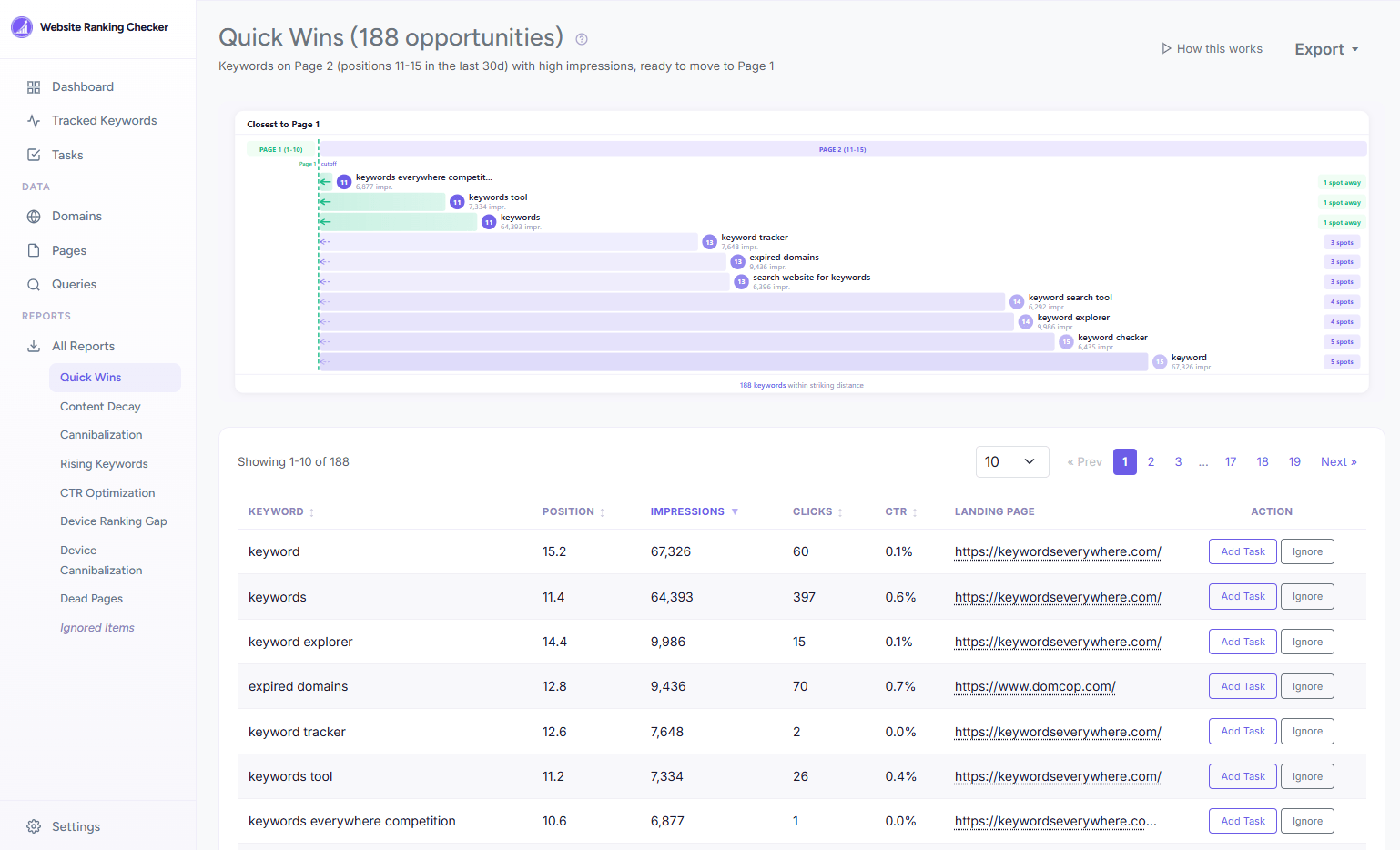
The pipeline, precomputed: every keyword one push from page 1, sorted by the demand waiting there.
Path 2: the long-tail ladder
Simultaneously: collect wins on rung 2, the specific queries where the best exact answer wins regardless of domain size.
Mine them from your own data first (the four filters): queries you already appear for at positions 8-20 are pre-validated. Add question-form variants and serve each with a dedicated section that says the words and answers the thing.
The compounding trick: every long-tail win adds a little authority and internal-linking power that makes the next rung slightly more reachable. Sites climb the ladder by winning rungs, not by staring at the top.
Path 3: new content, aimed honestly
For queries you don't appear for at all, new content, with two honesty checks before writing:
Can you win it? Read the current page 1. If it's all major brands with deep guides, that's rung 4 wearing a content brief. If it's thin, dated, or generic while the query wants something specific you can genuinely provide, it's winnable.
What's your clock? New pages on established sites settle in 1-3 months; new sites carry the slow clock regardless of content quality. Plan accordingly, and judge at day 60, not day 6.
Aim new content one rung up from your current wins, interlink it with the wins you have, and feed whatever queries it surfaces back into paths 1 and 2.
The 90-day plan
Weeks 1-2: baseline and targets. Verify GSC, start tracking, pull your query inventory. Pick: 5 quick-win keywords (11-15 with impressions), 10 long-tail targets (8-20, specific), 2 new-content gaps you can win. Write them down with current positions.
Weeks 3-6: the quick-win sprints. One keyword per week: title, content gap, internal links. Nothing else. Measure each after 2 weeks.
Weeks 7-10: content for the gaps. Ship the 2 new pieces, structured for their exact queries (and the answer boxes). Interlink with everything from weeks 3-6.
Weeks 11-12: measure and reload. What crossed to page 1? What moved but stalled? Refill the target lists from fresh data, log what worked, repeat the quarter.
Weeks 1-2, in one connect: Website Ranking Checker pulls your query inventory from Search Console, pre-computes the quick-win list, and tracks every target daily from the moment you pick it. Free for Keywords Everywhere users.
The scam tells
Because this query attracts predators, the field guide:
"Guaranteed first page ranking." Nobody controls Google. The trick behind the guarantee is always query-shifting: they'll rank you for "your-brand-name plumbing services in your-town-zipcode," declare victory, and invoice. If the query isn't named in the guarantee, the guarantee names nothing.
"We have a relationship with Google." No such relationship exists for organic results. This is a lie told confidently.
"Page 1 in 48 hours." Achievable exactly one way honestly: buying ads. Which is fine! Ads are a legitimate tool. Just know that's what's being sold, at recurring cost, with rented rather than owned visibility.
"Secret techniques." The techniques that work are documented and boring (this article is most of them). Secrecy in SEO sales predicts either spam tactics (your risk, not theirs) or nothing at all.
The honest sales pitch sounds like: "targets matched to your site's strength, visible progress in 90 days, page 1 on named queries as they become winnable." Anyone promising more is charging for the promise.
Common mistakes
Six page-1 campaign mistakes.
- Targeting head terms first. Rung 4 with rung 2 authority is effort donated to the void. Climb.
- "Page 1" without a named query. Unfalsifiable goals produce unaccountable work. Name the queries, write down positions.
- Ignoring the wins at 11-15. The fastest page-1 rankings are the ones you almost have. Most sites never look.
- Shipping content into unwinnable SERPs. Read page 1 before writing. If you can't beat what's there, aim elsewhere.
- Quitting at day 45. Both content clocks run longer than motivation does. The plan is 90 days because the data is.
- Not tracking the campaign. Untracked pushes teach nothing and repeat nothing. Positions before, actions logged, positions after.
FAQ
- How do I get on the first page of Google?
- Pick queries matched to your site's strength, then work three paths: push existing keywords at positions 11-15 over the line (title refresh, content gaps, internal links), win specific long-tail queries with exact answers, and build new content only for gaps you can honestly win. Track everything and expect weeks-to-months, not days.
- How long does it take to get on page 1?
- It depends on the query and your site. Quick-win pushes from positions 11-15 often cross in 2-6 weeks. New pages on established sites need 1-3 months to settle. New sites need months for long-tail wins and longer for anything competitive. Beware anyone quoting one number without asking about your site.
- Can I pay Google to be on the first page?
- For ads, yes: that's Google Ads, instant and legitimate, at recurring cost. For organic results, no: Google sells no organic placements, and anyone implying otherwise is lying. Ads rent the spot; SEO earns it.
- Do "guaranteed first page" services work?
- The guarantee is the tell. Since nobody controls Google's rankings, guaranteed-page-1 offers rely on ranking you for queries nobody searches (long brand-plus-location strings), running ads and calling it ranking, or simply not honoring the promise. Judge providers on named queries and measured progress instead.
- How many keywords can one page rank on page 1 for?
- Often dozens: a strong page ranks for its primary query plus a fan of related phrasings and questions. That's why winning one well-chosen query frequently drags a family of long-tail variants onto page 1 with it.
- Do I need backlinks to reach page 1?
- For specific long-tail queries, often not many beyond a healthy site: the exact answer wins. As you climb toward competitive terms, links increasingly decide ties between good pages. Earn them with content worth citing, and let internal links do the early lifting.
Your fastest page-1 candidates, precomputed
The Quick Wins report finds every keyword sitting at positions 11-15 with real impressions, from your own Search Console data, and keeps the list fresh daily. The 90-day plan's weeks 1-2, done before you start. Free for Keywords Everywhere users.
See your quick wins