

SEO KPIs: The 7 Numbers Worth Tracking (and the Ones That Just Decorate Slides)

Search "SEO KPIs" and you'll find lists of fifteen. Twenty. One ambitious soul compiled thirty-two.
Here's what a list of thirty-two KPIs actually is: a decision not to decide. When everything is a key performance indicator, the word "key" has filed for divorce.
A KPI earns the K by driving a decision. Someone sees the number move and does something different: reallocates budget, picks different work, approves a refresh sprint. Numbers that inform no decision are metrics (fine, keep them in a dashboard) or decoration (delete).
By that test, I count seven for SEO. Each one below comes with the decision it drives, the formula, where to read it free, and how to set a target that isn't fiction.
And because half the industry's favorite numbers fail the test, the vanity bench gets named too.
- A KPI must drive a decision. By that test there are about seven, not thirty-two.
- The seven: organic clicks to money pages, share-of-voice trend, position-band distribution, quick-win pipeline, total CTR gap, decay rate, and organic conversions.
- The vanity bench: site-wide average position, total keywords ranked, authority scores, raw impressions, and #1-ranking screenshots.
- Set targets from your baseline and trajectory, never from industry benchmarks: your query mix makes other sites' numbers incomparable.
The seven KPIs
1. Organic clicks to money pages. Not all clicks: clicks to the pages that convert (product, pricing, service, signup). This is the revenue proxy that survives contact with a CFO. Decision: is SEO working as a channel? Formula: filter GSC's Pages report to your money URLs, sum clicks, trend it. Free in GSC. Target: grow it quarter over quarter at your trajectory (method below).
2. Share of voice trend. The one-number portfolio headline: volume-weighted expected-click share across your tracked keywords (the exact formula, published). Decision: keep or change strategy. Where: computable in a spreadsheet, or computed daily for you. Target: direction and slope, not an absolute; real portfolios live far from 100.
3. Position-band distribution. How many tracked keywords sit at 1-3, 4-10, 11-20, 21-50, 51+. The shape tells you what kind of work the portfolio needs: a fat 11-20 band screams quick wins; everything in 21-50 says foundational content and authority. Decision: what kind of work gets scheduled.
4. Quick-win pipeline. Count (and expected-click value) of keywords at position 11-15 with real impressions. Your work-selection queue, quantified (the math). Decision: this month's optimization targets. Target: keep the pipeline non-empty; celebrate emptying it by refilling it.
5. Total CTR gap. Expected clicks minus actual clicks across your top-10 keywords (the curve times impressions, versus reality). Decision: whether the next sprint is title/snippet work (big gap, fixable causes) or position work (small gap). Also your zero-click exposure gauge.
6. Decay rate. Percent of your trafficked pages losing 25%+ clicks month over month (the thresholds). Ours has run around 40% in a bad month, and that number is what justified building refresh capacity into the content calendar. Decision: how much of next month is maintenance versus new.
7. Organic conversions. Sign-ups, leads, purchases attributed to organic. The only number on this list stakeholders fund without translation. Decision: everything upstream. Where: your analytics, not GSC. If you track one number from this article, track this one; the other six explain its movements.
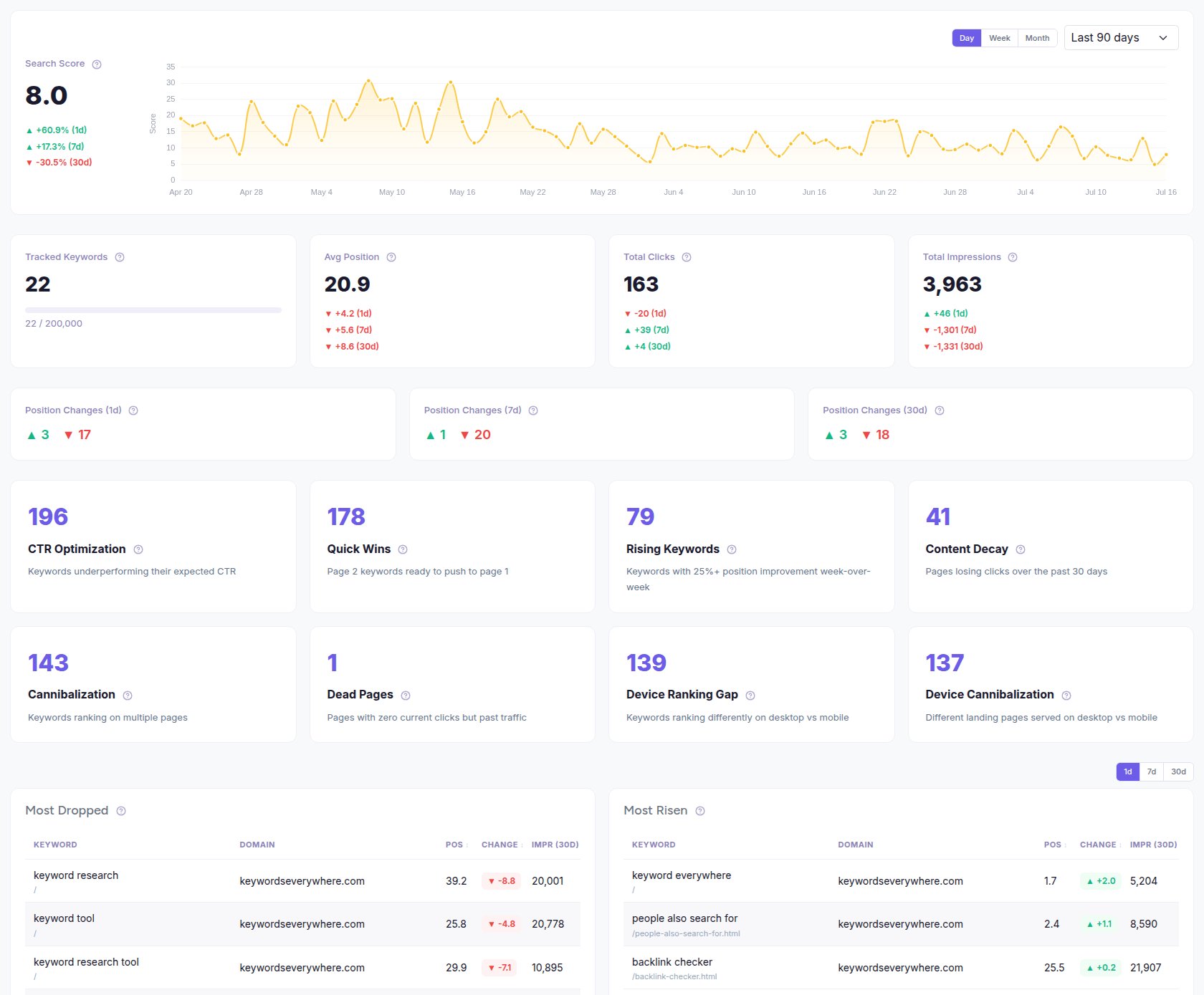
The dashboard version: distribution, movers, and the portfolio trend on one screen.
The vanity bench
Site-wide average position. Gains in long-tail rankings push it DOWN (new deep keywords enter the average) while your money keywords improve. A number that gets worse when things go well isn't a KPI; it's a prank.
Total keywords ranked. Publish anything and it grows. Says nothing about quality, value, or direction.
Authority scores. Third-party estimates of a thing Google doesn't publish, moved by recalibrations you don't control. Prospecting tools, not performance indicators.
Raw impressions as success. Impressions are the input to CTR-gap math and a visibility signal in the zero-click era, but "we were shown a lot" funds nothing by itself. Use them deliberately (as the informational layer's scorecard) or not at all.
The #1 screenshot. One keyword, one moment, one location's SERP. Motivating? Sure. A KPI? It's a sticker.
Traffic without segmentation. Total organic traffic blends brand (your reputation working) with non-brand (your SEO working). Splitting them is the difference between measuring the channel and measuring the company. More on that split soon.
KPIs by role
| Role | Watch monthly | Glance weekly | Ignore |
|---|---|---|---|
| Founder / owner | 1, 2, 7 | alerts only | 3-6 (your team has them) |
| In-house SEO / marketer | all seven | 4, 5 + alerts | the bench |
| Agency (client-facing) | 1, 2, 6, 7 | alerts | internal detail |
| Agency (internal ops) | 3, 4, 5 per client | alerts | the bench |
The pattern: the higher the altitude, the fewer the numbers. Founders get three. The bench helps nobody at any altitude.
Setting targets honestly
The industry's target-setting failure mode: adopting benchmarks ("sites in your niche grow organic 20% yearly") that were computed on other people's query mixes, ages, and authority. Comparable to you: nothing.
The honest method:
- Baseline first. Three months of your own data on each KPI before any target exists. You cannot target what you haven't measured.
- Trajectory second. Your last two quarters' slope is the null hypothesis. A target is a deliberate bet to beat your own slope, with named work attached ("ship 4 quick wins monthly, target SOV 8 to 11 by Q2").
- Attach the work. A target without a named mechanism is a wish. Every KPI target should reference which lever (quick wins, refreshes, new content, CTR fixes) is supposed to move it.
- Re-baseline after big events. Update hits, migrations, and list changes reset trajectories. Targets survive reality only if they're re-derived from it.
The review cadence
Monthly, in the one-page report: the seven, trended, with attribution. That's the KPI review.
Weekly and daily belong to alerts and dashboards (the thresholds), not KPIs. A KPI checked daily becomes a slot machine; the noise floor guarantees it.
Quarterly: re-derive targets from the new baseline, prune the tracked-keyword list, and re-ask whether each KPI still drives a decision. KPIs are a portfolio too; they decay.
The measurement layer, handled: Website Ranking Checker keeps KPIs 2 through 6 current daily from your own Search Console data: SOV, distribution, quick wins, CTR gaps, decay. Monthly review, ten minutes. Free for KE users.
Common mistakes
Six KPI failure modes.
- Thirty-two KPIs. A decision not to decide. Seven, with owners.
- Benchmark-based targets. Other sites' numbers were computed on other sites. Baseline and trajectory, or fiction.
- KPIs without attached levers. "Grow SOV" without naming the work is a hope with a deadline.
- Daily KPI-watching. That's what alerts are for. Monthly judgment, weekly glances, daily automation.
- Reporting the bench upward. Vanity metrics up the chain buy one good meeting and years of re-explaining.
- Never retiring a KPI. If nobody changed anything based on it for two quarters, it's a metric now. Demote it.
FAQ
- What are the most important SEO KPIs?
- Seven cover the decisions: organic clicks to money pages, share-of-voice trend, position-band distribution, quick-win pipeline, total CTR gap, content decay rate, and organic conversions. Each drives a specific decision; anything that doesn't drive one is a metric for dashboards, not a KPI.
- What's the difference between SEO KPIs and SEO metrics?
- A KPI drives a decision when it moves (budget, work selection, strategy). A metric is context you consult while acting on a KPI. Average position per keyword is a metric; the count of keywords in striking distance, which selects this month's work, is a KPI.
- How do I set SEO goals or KPI targets?
- Baseline each KPI for three months, take your recent trajectory as the default future, then set targets as deliberate bets to beat that slope with named work attached ("four quick-win pushes per month to lift SOV from 8 to 11"). Never adopt industry benchmarks; other sites' query mixes make them incomparable.
- What is a good SEO KPI for a small business?
- Organic clicks to your money pages, trended monthly, plus organic conversions if you can attribute them. Those two answer "is search bringing customers." Add the quick-win pipeline once you're actively optimizing; it tells you what to do next.
- How often should I review SEO KPIs?
- Monthly for the KPI review with trends and attribution; quarterly for target re-derivation. Daily and weekly attention belongs to threshold alerts, not KPI-watching: ranking noise makes daily KPI reads misleading.
- Is domain authority a KPI?
- No. Authority scores are third-party estimates useful for comparing link prospects, but they move for reasons unrelated to your performance and drive no monthly decision. Track outcomes (clicks, conversions, share of voice) instead.
Five of the seven, pre-computed daily
Website Ranking Checker computes your share of voice, position-band distribution, quick-win pipeline, CTR gaps, and decay list every day from your own Search Console data. Add your analytics' conversions and the KPI review assembles itself. Free for Keywords Everywhere users.
See your KPIs