

SEO for Bloggers: The Measurement-First Guide (Because the 27 Tips Aren't Working)

Picture a blogger who does everything the guides say.
She reads the 21-tip listicle and the 27-tip listicle. She optimizes titles, compresses images, adds alt text, fixes permalinks, installs the SEO plugin and turns everything green. She interlinks, she writes meta descriptions, she posts consistently.
Six months later, traffic is... fine? Maybe better? Which of the 27 things worked? No idea. Which were wasted effort? No idea. What should she double down on? No idea.
She didn't fail at SEO. She succeeded at 27 tactics and failed at the one thing none of the listicles led with: the feedback loop. Applying tactics without measurement isn't strategy, it's astrology with extra steps.
So this guide inverts the standard structure. Measurement first, on day one, before the tips. Then the tactics, in three phases, each one naming the number it moves, so that six months from now you know exactly what worked, what didn't, and where the next hour goes.
This is the guide I wish every blogger got instead of the checklists. Every claim in it is measurable on your own blog.
- Blog SEO advice fails as astrology: 27 tactics, zero attribution. Build the measurement loop first (GSC + tracking + a 15-minute monthly ritual), then apply tactics with scoreboards attached.
- Phase 1 is boring foundations (indexing, titles that match real queries). Phase 2 is writing for query families: each post targets a primary query and earns a fan of 20-50 variants. Phase 3 is the compounding loop: monthly quick-win pushes and decay watch.
- Ignore: authority scores, daily rank anxiety, keyword density, posting-frequency myths. Each fails the "what number does this move" test.
- The whole stack is free for most bloggers: Search Console + a GSC-powered tracker, plus a research tool for queries you don't rank for yet.
Measurement first (the day-one setup)
Before the first tactic: the 15-minute setup. Verify Google Search Console, connect a tracker, pick your tracked keywords (one primary per post that matters, plus the striking-distance surprises), set tiered alerts.
Then install the ritual: 15 minutes, once a month: movers, one quick-win push, a decay glance, a three-line log.
That's the whole apparatus, and it changes the meaning of everything downstream: every tactic below gets applied to a measured blog, so its effect shows up, attributed, within weeks. The blogger from the intro spent six months learning nothing; the measured version of her learns something every month, and compounds it.
Phase 1: foundations (week one, mostly once)
The boring 20% that carries most of the weight, each with its scoreboard:
Be indexed. Sitemap submitted, no stray noindex, pages appearing for site: searches. Scoreboard: GSC's Pages report. (The 5-minute diagnosis if anything looks wrong.)
Titles that match real queries. Your post title is your main ranking lever and your snippet. Front-load the query phrasing people actually use (your GSC data will correct your guesses within weeks), keep it under ~60 characters, promise the outcome. Scoreboard: CTR per query in GSC.
One post, one job. Each post targets one primary query family; overlapping posts cannibalize, and blogs are the worst offenders (three "best X" posts from different years, all ranking 15th). Scoreboard: one URL per money query, stable.
Site basics, once. Fast enough, mobile-sane, readable. Don't disappear into performance scores; get to "not embarrassing" and return to writing. Scoreboard: the mobile gap, occasionally.
That's the whole phase. Everything else the checklists put here (density, LSI sprinkling, plugin score-chasing) fails the scoreboard test.
Phase 2: write for query families
The unit of blog SEO isn't the keyword, it's the query family: a primary query plus the 20-50 variants, questions, and long-tail phrasings a good post earns (the fan-out). Writing for families changes how you write:
Pick the primary honestly. Match ambition to your blog's current strength (the difficulty ladder): young blogs win specific families ("sourdough starter troubleshooting") long before generic ones ("sourdough").
Answer the family, not just the keyword. The questions people ask around your primary (mine them with the regex) become your H2s and FAQ. Each question answered concisely is a family member captured, and an answer-box candidate.
Say the words. The family's phrasings belong in headings and paragraphs, naturally. Google matched you approximately; exact phrasing closes gaps. Scoreboard: the post's query count and positions in GSC, 60 days after publish.
Interlink on purpose. Every new post links to and from its topical siblings, anchored on real phrasings. This is the cheapest ranking lever on a blog. Scoreboard: the linked posts' positions, 4-6 weeks later.
Then watch the fan arrive. At day 60, read the post's real query list in GSC. The surprises ARE your next assignments: sections to add, posts to write, quick wins to push.
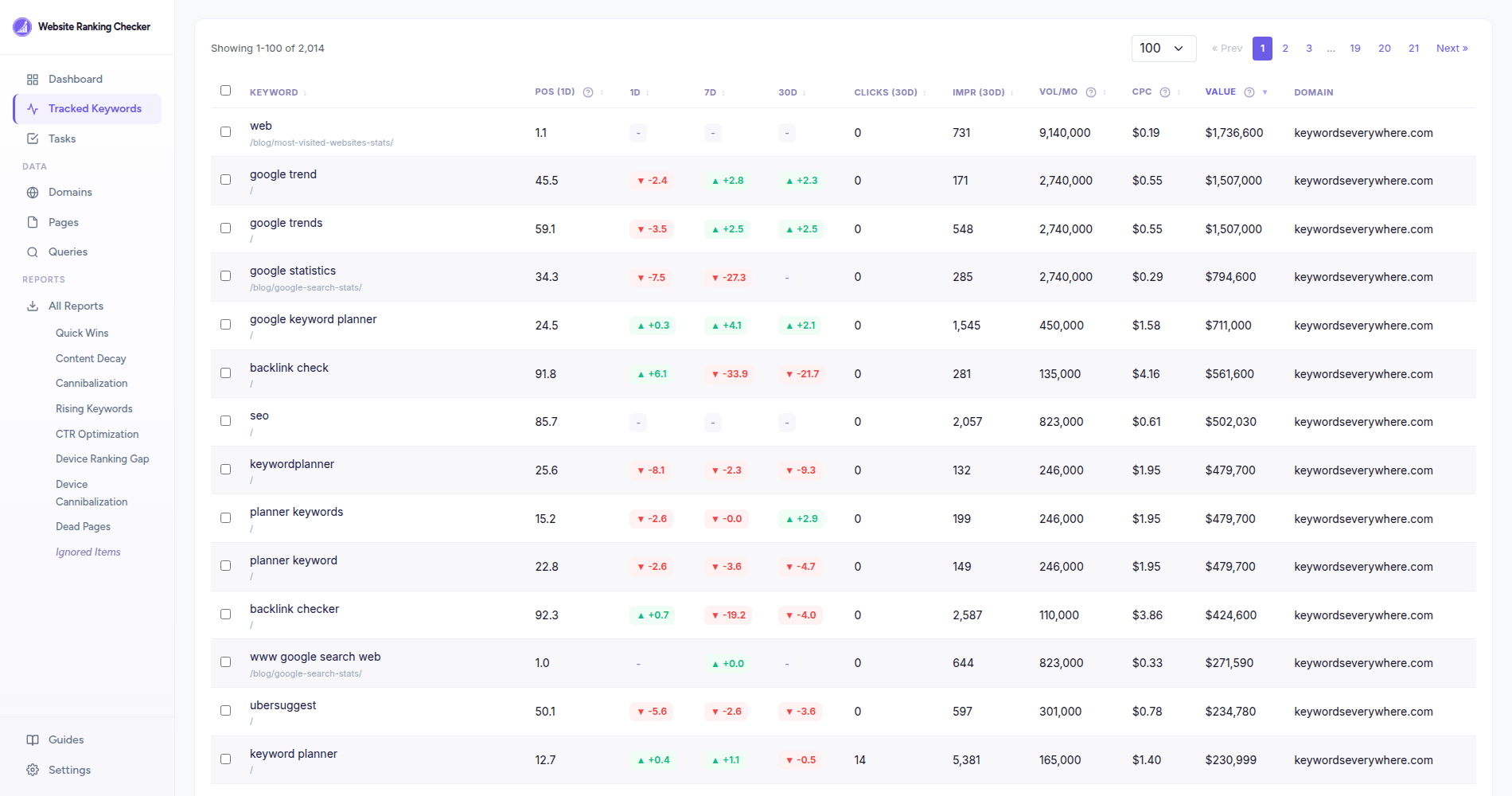
A measured blog: every family visible, every push attributable, the surprises surfacing themselves.
Phase 3: the compounding loop (from month two, forever)
Here's the part the listicles never say: a blog's SEO is mostly a maintenance economy. Across our own portfolio, 40% of pages with real traffic decline month-over-month; blogs churn harder. The winners aren't the blogs that publish most, they're the ones that defend and compound what works.
The loop, monthly:
One quick-win push. Your best position-11-15 keyword gets the treatment: title, gap, links. The math says this is the highest-ROI hour in SEO, and on a measured blog you'll watch it pay within weeks.
The decay glance. Any winner trending down 30+ days gets a refresh scheduled: substance, not date-stamps. Catching decay at -25% instead of -90% is worth more than most new posts.
The log. Three lines. What you did, what you expect, what happened last time. Twelve months of this and you have something no guide can give you: your blog's own playbook, calibrated on itself.
What to ignore
Each of these fails the "what number does it move" test:
- Authority scores. Third-party estimates that move for their own reasons. Not a KPI.
- Daily rank checking. Positions breathe daily (the noise floor); daily attention buys anxiety, not insight. Alerts plus the monthly ritual cover it.
- Keyword density. Died years ago; the corpse still tours the listicles. Say the words naturally; answer the family.
- Posting-frequency dogma. "Post 3x weekly" moves nothing by itself. One family-serving post that gets pushed and defended beats three orphans. Cadence should fit your capacity to also maintain.
- The 28th tip. If you can't name the metric a tactic moves on YOUR blog, skip it until you can.
The blogger's free stack
Three tools (detailed setup here):
- Google Search Console (free): the data. Every query, real positions.
- A GSC-powered tracker (ours is free for Keywords Everywhere users): the automation: daily history, tiered alerts, quick wins and decay precomputed, and you can literally ask it questions now.
- A research tool (Keywords Everywhere, from the family that builds our tracker): for the one job your own data can't do: queries you don't rank for yet, volumes at the moment of discovery.
Total for most bloggers: $0 beyond the KE subscription many already have. The expensive suites earn their fees on competitor intelligence, which most bloggers need later, if ever. (The honest comparison.)
The loop, mostly automated: Website Ranking Checker watches every post's family daily, alerts on real moves, and keeps the quick-win and decay lists fresh, so the monthly ritual is 15 minutes instead of an afternoon. Free for KE users.
The first-year timeline
Calibrated by the three clocks, for a newish blog:
- Weeks 1-4: foundations + first family posts. Impressions trickle in, tiny and weird. Normal.
- Months 2-4: long-tail impressions grow; first clicks on specific families; the fans become visible at day-60 checks. Feed them.
- Months 4-8: the loop compounds: quick wins push winners onto page 1; refreshes defend them; specific families are yours.
- Months 8-12: medium terms come into range as authority accumulates. The measured blog knows which ones; the unmeasured one is still guessing.
An established blog compresses this drastically: the loop starts paying in month one, because the query inventory already exists.
Common mistakes
Six blogger-SEO mistakes.
- Tactics before measurement. Six months of unattributed effort is the default blogger experience. Loop first.
- Writing new posts while winners decay. The maintenance economy is real; defense compounds better than volume.
- Targeting rung-4 keywords with a rung-2 blog. The ladder decides what's winnable; ambition doesn't.
- Ignoring the fan. The post's real query list at day 60 is your roadmap; most bloggers never read it.
- Cannibalizing yourself annually. "Best X 2025", "Best X 2026" as separate posts: one family, one URL, updated.
- Quitting inside the slow clock. Months 3-6 is when long-tail starts paying and when most blogs go quiet. The measured blogger sees the climb and keeps going.
FAQ
- How do bloggers do SEO?
- Measurement first: verify Search Console, track your keywords, and run a 15-minute monthly review. Then three phases: foundations (indexing, query-matched titles, one post per topic), writing for query families (a primary query plus the questions around it, interlinked), and the compounding loop (monthly quick-win pushes and decay refreshes).
- How long until a blog gets SEO traffic?
- On a new blog: impressions within weeks, first clicks on specific long-tail queries around months 2-4, compounding from months 4-8, medium-competition terms toward the end of year one. Established blogs move much faster. Judge new posts at day 60, not day 6.
- How many blog posts do I need before traffic arrives?
- Fewer, better-aimed posts beat volume: a handful of posts each serving a specific query family, interlinked and maintained, outperform dozens of orphans. The number that matters isn't post count; it's how many query families you've won and defended.
- Do bloggers need paid SEO tools?
- Mostly no. Search Console is free and complete for your own data; GSC-powered trackers add automation free (ours, for Keywords Everywhere users); a research tool helps for queries you don't rank for yet. Paid suites earn their cost on competitor intelligence, which most bloggers can defer.
- Should bloggers update old posts or write new ones?
- Both, on a maintenance-first budget: roughly 40% of trafficked pages decline month-over-month across our portfolio, and blogs churn harder. Defend your winners (refreshes, quick-win pushes) before adding volume; one maintained winner beats three new orphans.
- How often should a blogger post for SEO?
- There's no magic frequency: Google rewards pages that win query families, not calendars. Post at whatever cadence lets you also maintain what you've published; a sustainable rhythm with the monthly loop beats a sprint followed by decay.
The measurement loop, running while you write
Connect Search Console once and Website Ranking Checker tracks every post's query family daily: history, tiered alerts, quick wins and decay precomputed, the monthly ritual mostly automated. The feedback loop this whole guide is built on, free for Keywords Everywhere users.
Start measuring your blog